
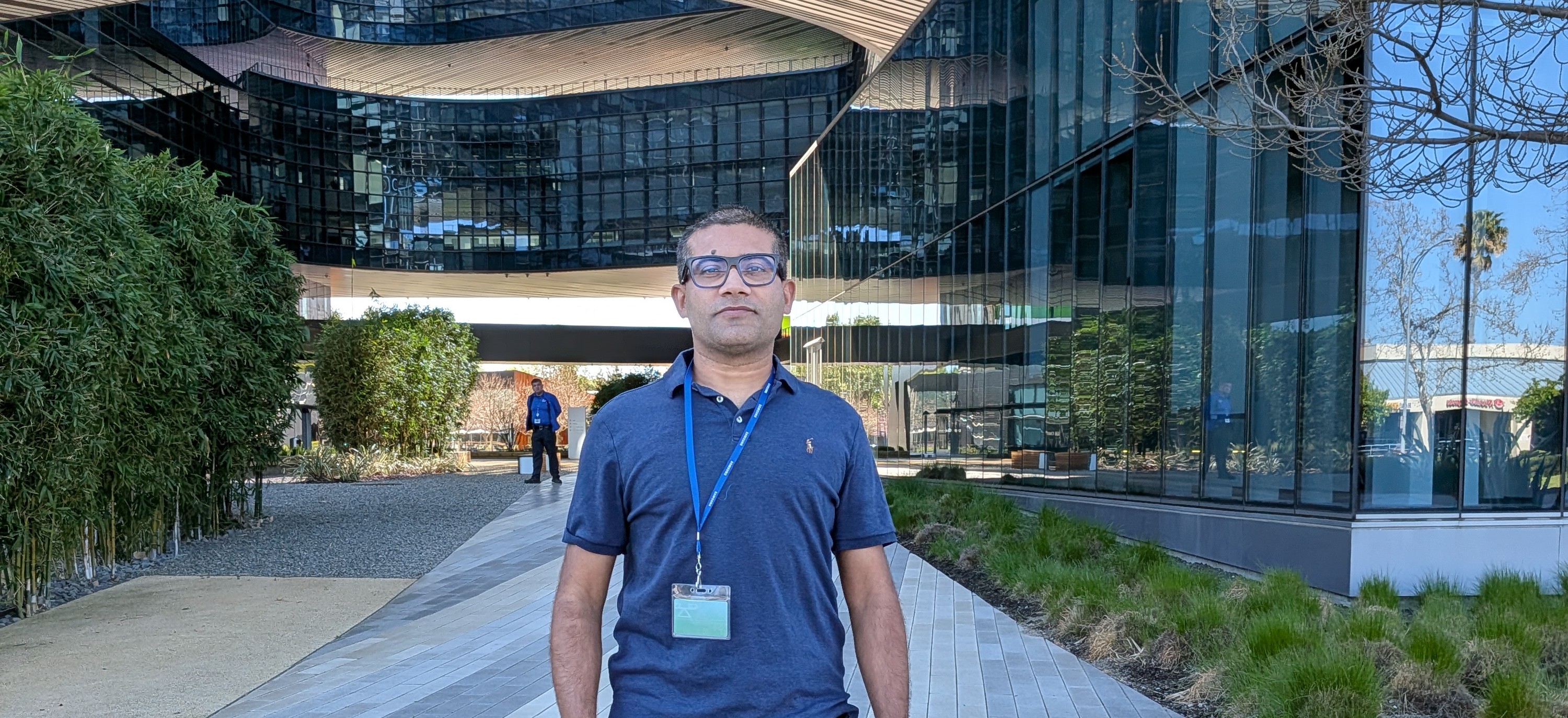
Tamim Islam, Ph.D. grew up in Bangladesh with a curiosity for technology and a love of problem-solving. When it came time to pursue his doctorate degree in computer science, he had a specific goal: he wanted to work on video conferencing — and he found exactly the right person to work with at ÌìÌì³Ô¹Ï State.
"I found that Dr. Javed Khan was working on video conferencing," Islam said. "That was the main motivation."
What followed was a doctoral academic journey that took him far beyond his original interest, shaped by the depth of ÌìÌì³Ô¹Ï State's graduate program and a mentorship built on trust and intellectual freedom.

Finding His Research Path
Under Khan's guidance, Islam's research evolved naturally. He quickly discovered that the real bottleneck in video conferencing wasn't the application -- it was the network. That led him into network algorithms, and from there into hardware design.
"Many network algorithms in routers are implemented in hardware because they need to process billions of packets per second," Islam said. "That's how I got into high-level synthesis."
High-level synthesis, a method for generating complex hardware designs from higher-level code, became central to his dissertation. He developed network algorithms, built a synthesis tool, and used it to generate hardware implementations. It was rigorous, applied work that would prove directly relevant to his career.
Islam said that Khan was instrumental, not by directing every step, but by giving him room to grow. "He gave me the freedom to pursue my own interests, and very good direction when I needed it. It was a great partnership."
A Program Built for Industry
Islam said that ÌìÌì³Ô¹Ï State's graduate courses are what truly set the program apart. Advanced networking, parallel and distributed computing, algorithms and big data -- these courses were stimulating and challenging, designed to make students think deeply.
"You learn real, advanced things," Islam said. "Those are very applicable in industry, because industry is much more advanced than what you encounter at the undergraduate level."
His years as a teaching assistant reinforced that foundation. Teaching design patterns and advanced programming, connecting real-world examples to underlying concepts, meant he internalized material at a level most students don't reach.
"I didn't need to do separate interview preparation," Islam said. "Teaching those subjects meant I already knew them."
A Career in Motion
After graduating in April 2023, Islam moved to California and joined Juniper Networks, applying his expertise in network algorithms to the design of core Internet routers. Less than two years later, he made another leap, to Samsung Advanced Computing Lab in San Jose, where he now works on GPU hardware for Samsung's smartphone chips, improving graphics performance and parallel processing.
It's a long way from video conferencing research, but the thread connecting it all runs back to ÌìÌì³Ô¹Ï.
"I still use those fundamentals everywhere I go," Islam said. "When I came to Samsung, I didn't know GPU architecture, but having a strong foundation and that way of thinking, those are the same everywhere."
Why ÌìÌì³Ô¹Ï State
Even from Silicon Valley, just two miles from Stanford, Islam's affection for ÌìÌì³Ô¹Ï State is unmistakable.
"ÌìÌì³Ô¹Ï State is one of my favorite campuses," Islam said. "I've visited many universities across the U.S. and it's still near the top. The environment is friendly, inclusive, welcoming. I was always studying, but it never felt like work."
For students considering a graduate degree in computer science, his advice is clear.
"The program is very good in quality,� Islam said. “The courses prepare you for the real world. I would highly recommend it to anyone."
# # #