
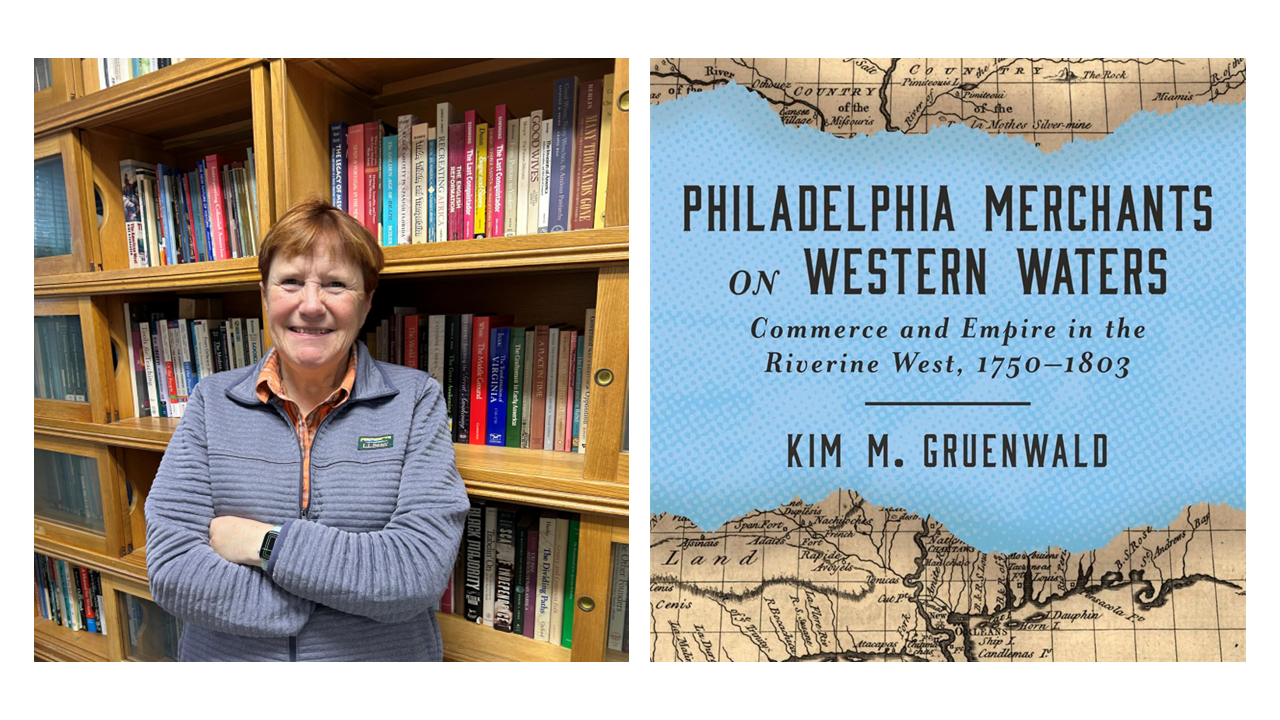
In his continuing series of interviews with his departmental colleagues, Professor Steigmann-Gall this semester interviews Professor Kim Gruenwald, about her book that came out last Fall, Philadelphia Merchants on Western Waters, and 鈥� as our resident specialist on Colonial America 鈥� about the upcoming 250th anniversary of the signing of the Declaration of Independence.
RSG: Kim, tell us about your new book. It鈥檚 about the economics of the Ohio Valley, right? How does it relate to your first book?
KG: It is about Philadelphia merchants who are doing business down the Ohio and Mississippi Rivers from 1750 to 1803. And in some ways, it鈥檚 a prequel to the first book, which went from 1790 to 1850. But I realized that I was less interested in steamboats and railroads, so I went back in time instead. For me, there's something intriguing about a time period where the fastest you can go is on your feet, or on a horse or ship. I鈥檓 drawn to an era where that's the speed of travel.
RSG: And so the river becomes more important?
KG: I hadn鈥檛 planned this at the start of my career, but I seem to be interested in regions, especially the role that rivers play in their development. Back when I was trained as a graduate student, the New Western History focused on the West as a place across the Mississippi River, and rejected Frederick Jackson Turner鈥檚 definition of the frontier as a moving line of settlement. They're studying the West as a place across the Mississippi. So then, what got left out?
RSG: The East?
KG: One thing that struck me a couple of years ago was how Colonial America is all about the Atlantic World, and then ships navigating up to the fall line of the rivers. Then, with Lewis and Clark, it's the overland journey, with wagons and then railroads. So what's in between the Atlantic World and the Overland routes? A river world.
RSG: And that鈥檚 where your scholarship comes in?
KG: Yes. And you know, you've got the Spanish on one side, and the English on the other, up the Mississippi. Or, you've got White settlers on the south bank of the Ohio and Native Americans controlling the north bank. The Louisiana Purchase in 1803 finally sees Americans controlling both banks of the Ohio and Mississippi River. And that's the foundation of America's continental empire.
RSG: Johns Hopkins is a very prominent press. I remember your first book was with Indiana University Press; how did how did you make your way to Johns Hopkins Press with this book? 鈥�
KG: They made sense for a book about commercial connections in early America. They were the best press for the topic, so I decided to give it my best shot.
RSG: Given the era you investigate, did they or you think of tying in the book with this year鈥檚 Semiquincentennial of the Declaration of Independence?
KG: No but it did make me think about the founding narratives of the United States.
RSG: Speaking of narratives, I wanted to ask you about your teaching. As the resident specialist in the department on Colonial America, does the 250th this year have an impact in your classroom, would you say?
KG: I鈥檓 drawn to the idea of great economic change, the expansion of empires. I鈥檓 interested in individuals engaging in trade, practical people who pay no mind to whose empire or territory it is. In my teaching, I tend to lead with economics, and ask about the kinds of conditions 鈥� material and political 鈥� that lead to cultural phenomena like the Great Awakening, and then the Great Awakening makes these broader changes to culture. It鈥檚 like my attitude to Frederick Jackson Turner. When I did my graduate work, The University of Colorado was at the heart of the New Western History. I always believed that Turner was right, but that he got some of the story wrong. His story of rugged individuals who encountered Native Americans only as obstacles to progress left so much out. The nuts and bolts of historical change start with the economics, I think. You can't talk about the change of the economy, religion, and government as separate things. They rub against each other, like rocks in a stream. The stream goes over them and they work together, you know?
I would say that my research and my teaching are both joined in this: they come out of the feeling that historical figures are responding to their environments, even as they are changing that environment. The question becomes: how did they create order out of that environment? I want my students and my readers to think about people of the past. Not just that they鈥檙e making decision, but why are they making those different decisions. Creating meaning out of seemingly random decision-making.
I love telling a story, like the story of the Salem Witch Trials. Many of us view the Salem Trials as about deeper things; whether it鈥檚 scapegoating, power dynamics, patriarchy, or group cohesion. But we also have to remember that those people actually believed in witches. The material backdrop of the Trials is important, but so were the beliefs.
RSG: Yes, I see your point. This urge to see everything in the past as a mere reflection of current conditions.
KG: I try to tell my students that people of the past are exactly like you. Economic change destabilizes society. Children get sick. Communities confront crisis. But even if what we know now is different compared to then, the people of the past are the same as you. The urge to apply the lessons of History for today confronts this paradox: people of the past are entirely different, but also in many ways exactly the same. People of the past, their community, their society is based on the context of where they live. I try to get my students to learn to respect that. This is how my teaching and research inform what I do.
That's who I am as a teacher; getting students to understand, seeing the historical point of view. That realization makes them better citizens.
RSG: So, it's like that idea that the past is a foreign country, except the students are still citizens of that country.
I think that perfectly transitions us to your teaching. And I also want to touch on your big event in February, about this year鈥檚 250th Anniversary of the signing of the Declaration of Independence. It was a packed house! I like how you encouraged your audience to engage their own critical thinking and make their own connections. Do you do that in the classroom all the time?
KG: It's their world. I think the problem with the world is short term thinking. And people reacting as if others don't have a history, a context, beliefs of their own. They're exactly like you and nothing like you at the same time. They are exactly like you in terms of wanting safety, family, all the things human beings want. But they also believe different things. That鈥檚 one thing I hope students in my classes come away with.
When I was an undergraduate, I took a class in college with a woman who specialized in Puritans. Our final paper focused on how Nathaniel Hawthorne's The Scarlet Letter had nothing to do with Puritans. I mean, that's a 19th century novel that's about Hester Prynne and Puritans that gets every single bit of the history wrong. Our final paper was about that, about the wrongness. Hester Prynne lived on the outskirts and tempted people. But in actual Puritan society, she would have been with a family where a man just sat on her and controlled her. In reality such a woman either accepted tight supervision, or she was completely exiled. There would have been no periphery where sinful people could live in proximity, either geographically or socially. We need to teach what actually happened in the past, not what people think happened.
Like you Richard, I don鈥檛 use powerpoint. I like writing on the board; it slows me down, which is necessary because otherwise I鈥檇 talk too fast.
RSG: And gives you an immediacy, perhaps, too? A feeling of immediacy that you're writing and you're being sort of pedagogically creative?
KG: Exactly! The only perfect technology is a chalkboard. It never fails you. You're engaging and being engaged, you're being interactive, and as the students have questions, you write them on the board.
RSG: That talk you gave on the 250th. I love how you called it 鈥渢he 50th anniversary of the Bicentennial.鈥� It seemed to me that this was about more than just the awkwardness of 鈥淪emiquincentennial鈥�? Can you talk about that?
KG: It鈥檚 a very generational thing. When I was a kid, everyone watched those shorts on TV, called 鈥淏icentennial Minutes.鈥� But aside from this being a reference to my own upbringing, I think it has deeper meaning. I wanted the audience to think about what their memory of this 250th is going to look like. Thomas Paine said 鈥淕o forward, not back.鈥� Many today want to go back, to seek historical reference points for identity. As I prepared that talk, I asked myself a question which I then passed on to my audience: what exactly are we commemorating and why? The actual birth of the United States is more arguably the Articles of Confederation, or the Constitution. Our decision that the Declaration of Independence would be the thing to get celebrated has to be contextualized. Turns out, it was about finding allies in the world. By making our case that we were a nation in the world, equal to other nations. So, we made a conscious choice to infuse that with meaning, but the choice was arbitrary.
RSG: I mean, the French decided that their national day commemorates when the National Guard were going to try to grab a bunch of guns from the arsenal and then accidentally got shot at. It's not when the Declaration of the Rights of Man and the Citizen was written. It wasn't the Tennis Court Oath, when the National Assembly was founded. So this moment of violence was freighted with meaning, in a similarly arbitrary way.
KG: I鈥檒l add that Lincoln decides our Declaration is a kind of sacred text 鈥� he tied it to the Civil War. These ideals were written by men who didn鈥檛 understand them as we do today. But it still creates the framework for further progress. Even if it wasn鈥檛 until later that women and people of color got the right to vote, I鈥檇 make the case that these achievements still represented the triumph of that framework.
When I think of the 50th anniversary of the Bicentennial, I also think of two popular cultural events that really helped shape our national identity. One was the movie Rocky, and the other was the novel Roots. Both came out in 1976, with the TV miniseries Roots coming out the next year. Those two productions both represented cultural inflection points. Both invited their viewers to look at struggle. Things were iffy in 1976. Nixon had resigned, and we had in President Ford someone who was not elected by the people, even to be vice president. The pullout from Vietnam was two years before that. There was a sense of pessimism. And there was no national program to celebrate the Bicentennial 鈥� the federal government booted it to the states. And the 鈥淏icentennial Minutes鈥� were done by the networks. The federal government played no role in making those.
Who knows, perhaps they set me on a path to becoming an historian? I challenged students at the talk to think about how they might remember the 250th. How do they feel at this moment? I wanted to leave them with this question.
