
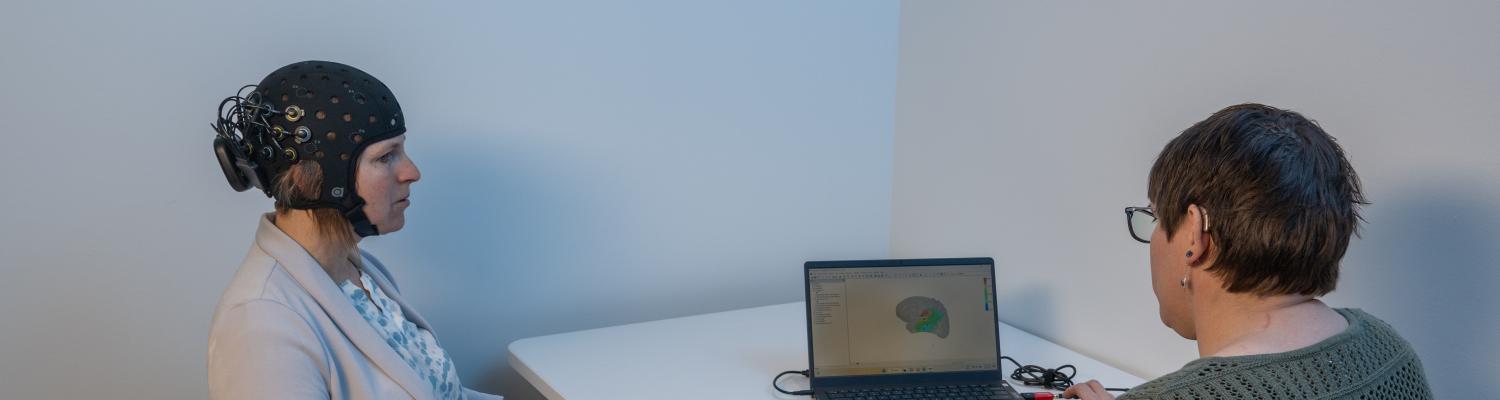
Neurocognitive Collaboratory
The Neurocognitive Collaboratory is equipped with a fully Integrated Artinis Brite fNIRS EEG System, an 8X8 NIRSport2 fNIRS system, and data analysis software.
Near infrared spectroscopy (NIRS) relies mainly on the relative transparency of tissue to light in the NIR range, and the oxygenation-dependent light-absorbing characteristics of hemoglobin. By using several different wavelengths, the relative changes in hemoglobin concentration can be displayed continuously. fNIRS stands for 鈥渇unctional near infrared spectroscopy鈥�. The functional component comes from the fact that fNIRS devices can assess brain activity.
To better understand whether fNIRS is the right fit for your project, please use the link below to learn more about the fundamentals of fNIRS and items to consider when planning your project:
EEG, or electroencephalography, is a noninvasive method to measures the electromagnetic field created when neurons in the brain fire. The equipment captures, amplifies, digitizes and displays brain wave patterns for analysis.
For more information about using the Neurocognitive Collaboratory resources, please go to our Using BHRI Resources page.
To schedule a consultation on study design, use of instrumentation, or image analysis or for technical support, please email the BHRI Assistant Director of the Neuroimaging Collaboratory, Dr. Kathleen Casto at kcasto6@kent.edu.
